
A reed diffuser's unopened shelf life is different from how long it lasts after the reeds are inserted.
The first concerns whether the sealed product stays within its approved quality limits during storage. The second is the time it takes the liquid to evaporate during use. Buyers should ask for evidence for the first instead of inferring it from a “90-day” or “six-month” use-life estimate.
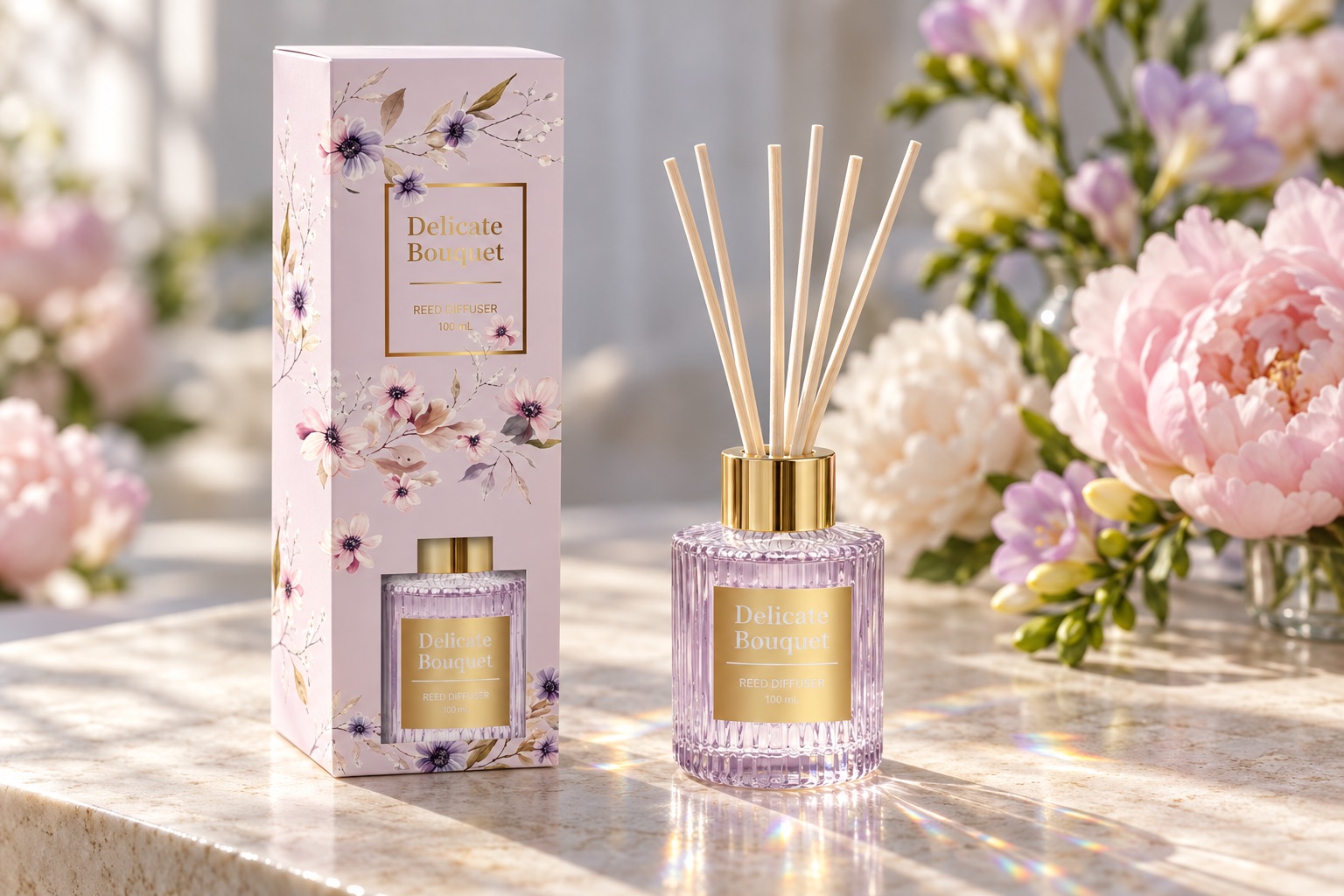
What Does Shelf Life Mean for a Reed Diffuser?
For a finished product, shelf life is the period during which a sealed reed diffuser is expected to remain acceptable under defined storage conditions. The formula, bottle, closure, label and outer packaging all matter. A fragrance liquid that remains stable in a laboratory vial may behave differently in the final bottle, where it contacts a stopper, liner, collar, coating or label.
| Time Frame | Question It Answers | Evidence Needed |
|---|---|---|
| Unopened shelf life | Does the sealed product remain within approved limits during storage? | Finished-product stability records |
| In-use life | How long does the liquid last after the reeds are inserted? | Controlled diffusion and evaporation test |
| Transit exposure | Does temporary heat, cold, vibration or pressure damage the shipment? | Route-relevant transport and pack testing |
These periods answer different questions and should not be treated as interchangeable.
What Can Change During Storage?
Fragrance concentrates vary in color, solubility, viscosity and volatility. A change in fragrance, base or concentration can affect clarity, odor, color or the way the liquid interacts with its packaging. Some formulas may become cloudy at low temperatures, while others may darken after light exposure or develop sediment. The behavior is formula-specific.
Packaging can also affect the stored product. A closure or liner may soften, swell or lose sealing performance after extended contact with the formula. Slow evaporation or leakage can change the fill level and leave residue on a label or carton. Direct sunlight and excessive heat can accelerate visible changes, so actual storage conditions belong in the evaluation plan.
How Should Buyers Check Reed Diffuser Stability?
Test the final formula in the intended retail bottle and closure, with the production label and relevant packaging components. Record the formula code, material suppliers, packaging version, fill quantity, batch and storage conditions for every sample group.
At planned checkpoints, inspect and record:
- Liquid clarity, color, sediment or separation
- Odor changes compared with the approved reference
- Fill level or weight loss in the sealed package
- Leakage, residue or staining around the neck, closure, label and carton
- Changes to the bottle, stopper, liner, collar, coating or label adhesion
Set checkpoints and pass criteria before testing. Real-time storage testing shows how the finished product behaves over time under the selected conditions. Elevated- or low-temperature tests can help screen for weaknesses, but a short accelerated test should not automatically be converted into a precise number of months on a label.
A passing appearance check at one date is not enough to support a longer shelf-life claim. Retain samples and results so the statement can be traced to the exact formula and package tested.
How Should Reed Diffusers Be Stored Before Sale?
Keep products sealed in their approved packaging, upright, in a cool, dry area away from direct sunlight and heat sources. Follow the storage range established for the product and avoid unnecessary opening or repacking. Maintain batch and receipt dates, and use first-in, first-out stock rotation so older inventory is shipped first.
Monitor warehouse conditions, especially during seasonal temperature changes. If products may experience hot or cold transit conditions, evaluate those exposures separately from normal warehouse storage. A shipment test does not replace shelf-life testing, and shelf-life testing does not replace a shipment test.
When Should Stability Be Rechecked?
Reassess the product when a change could affect the formula or packaging: a new fragrance supplier, revised fragrance composition, different base or concentration, bottle material, closure, liner, label adhesive or coating. A visually similar component is not automatically equivalent in long-term contact with diffuser liquid.
For repeat orders, compare the production batch with retained samples and the approved specification. Keep change records so a quality issue can be linked to the relevant formula and component versions.
Buyer Checklist for Shelf-Life Claims
- Does the statement refer to unopened storage or in-use duration?
- Was the final formula tested in the production bottle and closure?
- Are the tested label and packaging versions the same as the order?
- What storage conditions and checkpoints were used?
- Which appearance, odor, weight-loss and packaging criteria were recorded?
- Is the stated period supported by results for this specific product?
- Will a formula or component change trigger a new review?
The Final Takeaway
Connect Every Shelf-Life Statement to a Tested Configuration
A reliable reed diffuser shelf-life statement belongs to a defined formula, package and storage condition. Ask the supplier to connect the stated period to the actual test record, and keep storage instructions consistent with the conditions used to support it.
For a private-label order, send UNION AURA your formula direction, bottle and closure specification, label construction, destination markets and expected storage period so a project-specific stability plan can be discussed before bulk production.
Review what reed diffuser oil is made of, use the sample approval checklist, or see how QC continues during mass production.