
A reed diffuser can match its approved sample and still vary during a large production run.
Material lots, filling equipment and similar components can all introduce differences. Buyers therefore need checks tied to the approved specification and records that identify the affected units when a result falls outside the agreed limit.
A practical quality-control plan connects incoming materials, in-process checks, finished-product inspection and batch records. Acceptance criteria should be agreed before production so the team knows what to check and how a lot will be released.
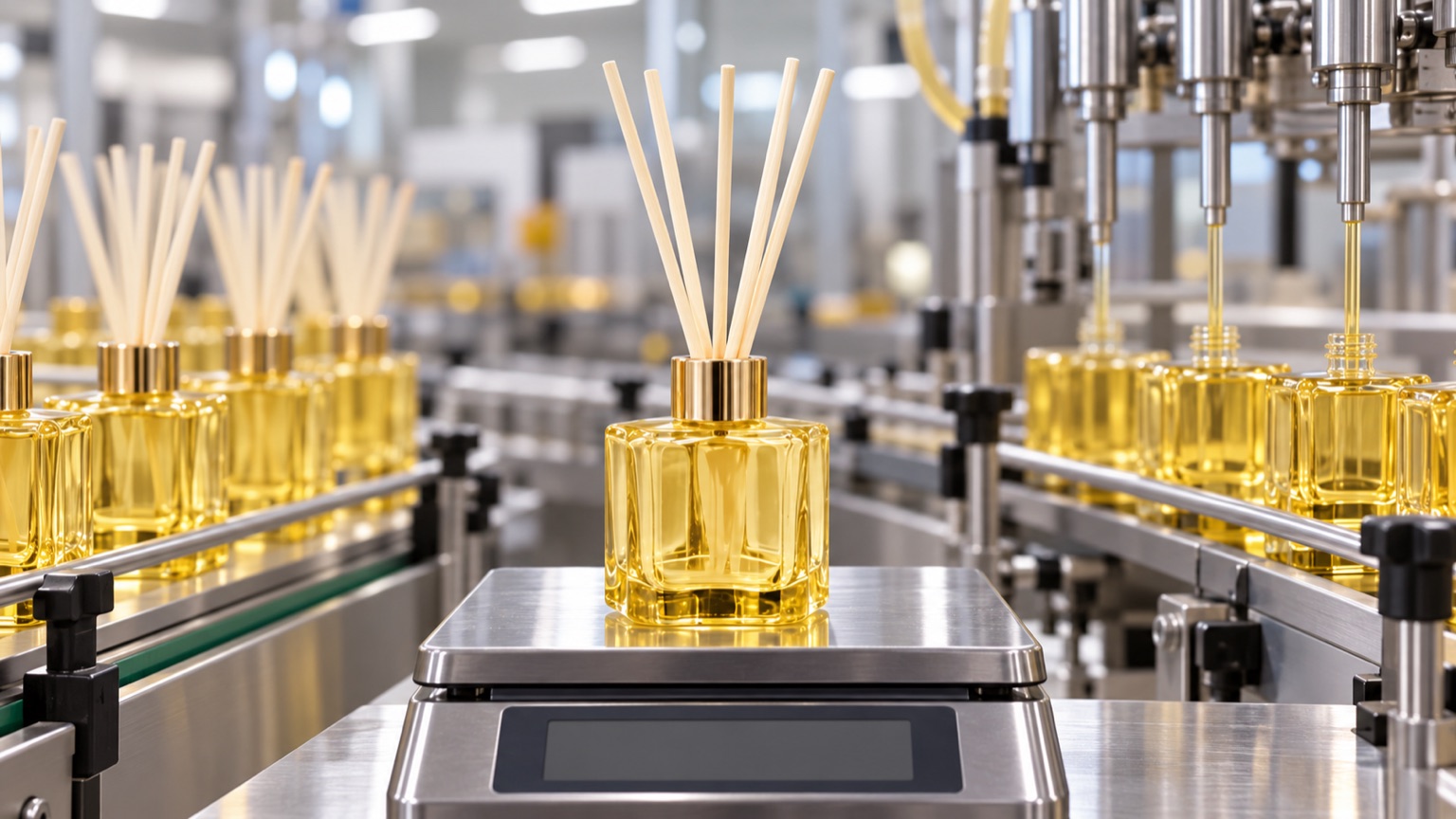
1. Set the QC Standard Before the Run
The approved specification is the reference for every production check. It should identify the formula code and revision, bottle and closure, fill target and tolerance, reed material and dimensions, component count, artwork version, packaging configuration and required test criteria.
Define measurable limits: the fill target and method, acceptable label placement and an agreed sensory reference. An operator's memory is not a reliable fragrance standard.
A signed sample can serve as a visual and sensory reference, but it does not replace written specifications or a sampling plan. Any change to formula, supplier, bottle, closure or artwork requires an authorized revision before use.
2. Check Materials Before They Reach the Line
Incoming checks help catch mix-ups before they become a full-batch problem. Confirm the identity, code, lot and release status of fragrance ingredients and bases. Check bottles, stoppers, caps, reeds, labels and cartons against the approved component list and artwork revision.
For reed diffuser liquid, compatibility matters as much as appearance. A closure or liner that looks correct may still soften, swell or lose its seal after contact with the actual fragrance formula. Where compatibility is a project requirement, assess production components with the finished formula—not water alone.
Keep material lot numbers connected to the production batch. If a defect is discovered later, the record should show whether it affects one component lot, one production window or the entire order.
3. Monitor the Batch and Filling Line
During production, use checks that can detect developing drift before many units are affected. Depending on the specification, operators may verify liquid appearance, color, odor and uniformity before release to filling. At the line, check fill quantity using the specified method, then confirm bottle cleanliness, closure fit, label position and the required reed and accessory count.
Record results at start-up, after adjustments or stoppages, and at agreed intervals. Frequency should reflect equipment, order size, defect risk and customer requirements; no single interval or sample percentage fits every product.
For fill control, state whether the target is expressed by mass or volume and how it is measured. Do not compare readings taken with different methods as if they were equivalent. If a result falls outside the agreed range, identify the last acceptable check and hold units produced since then.
4. Inspect Finished Units and Packed Cartons
Finished-product inspection should confirm the diffuser as a complete set. Check for visible bottle or decoration defects, residue, leakage, incorrect labels, missing reeds or accessories, and packaging that does not match the approved version. Verify that carton quantity and markings agree with the packing instructions.
The inspection plan should state the lot definition, sampling method, defect categories and acceptance criteria. Some buyers use an AQL-based plan; when they do, the inspection level and limits should be agreed in advance. AQL does not replace clear defect definitions, and it should not be treated as permission to ship a known critical issue.
A visual inspection cannot prove every performance claim. If diffusion, leakage resistance or package compatibility is a purchase requirement, define the test method, sample configuration, conditions and pass criteria separately. For leakage evaluation, use the finished formula and production closure, then inspect the bottle, liner, label and carton for damage or residue.

5. Contain Defects and Document the Decision
When a check fails, segregate affected units. Record the defect, quantity or batch range, investigation, authorized disposition and reinspection. Rework should be approved and documented; informal line changes undermine traceability.
The buyer should be able to connect released cartons to the formula revision, raw-material and component lots, production batch, inspection results, packing quantity and any approved deviation. For repeat orders, these records help distinguish process changes from normal variation and support complaint investigations.
What Buyers Should Confirm With a Supplier
- Which approved specification and component revisions will control the run?
- What incoming, in-process and final checks are recorded?
- How are sample frequency and acceptance criteria defined?
- What happens to units made after a failed check?
- Can finished cartons be traced to the batch and material lots?
- How are deviations, rework and repeat inspections approved?
The Final Takeaway
Reliable QC Is Visible in the Records
A reliable reed diffuser QC process links approved criteria, incoming materials, production checks, finished inspection and prompt containment. That gives buyers a sound basis for releasing the order and comparing future batches.
For a private-label production plan, send UNION AURA your approved product specification, order quantity, target market and inspection requirements. The QC checkpoints and records can then be aligned with the product and order before the run begins.
Review the sample approval checklist, follow the reed diffuser production process, or explore our reed diffuser manufacturing capabilities.