
A common question during reed diffuser development is: Can we increase the fragrance percentage to make it smell stronger?
Sometimes—but not always. A higher fragrance load can also make the liquid harder to wick, affect clarity, shorten product life or create compatibility problems.
Reed diffuser oil is not simply fragrance poured into a bottle. Most commercial formulas contain a diffuser base, a fragrance concentrate and, where needed, a small amount of color or other functional ingredients. How these parts work together matters more than any one percentage on a formula sheet.
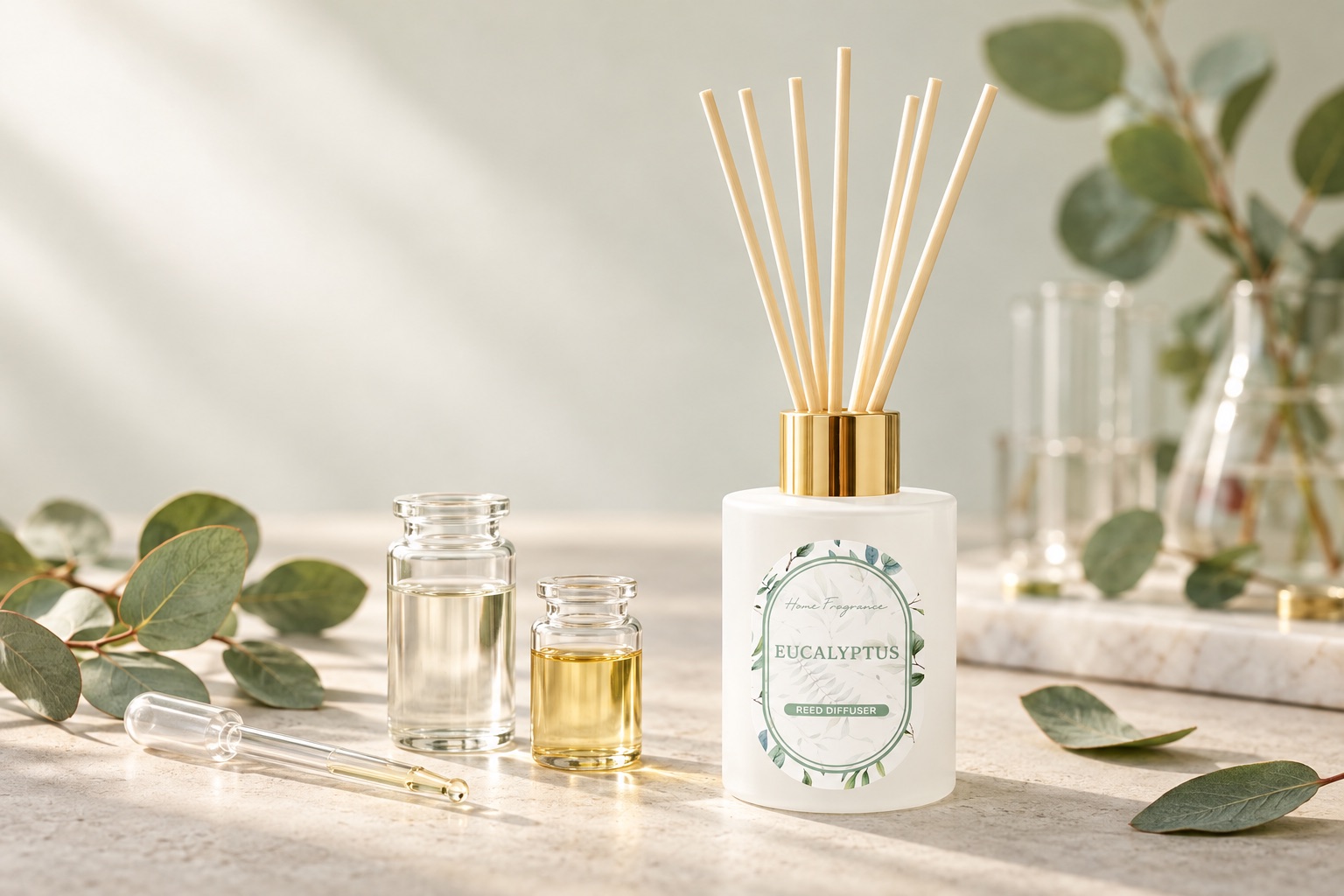
What Is in Reed Diffuser Oil?
Despite the name, reed diffuser “oil” is not necessarily a plant oil, and it is rarely pure essential oil. The word oil is often used as a general market term for the scented liquid inside the diffuser.
A typical commercial formula has three parts.
1. Diffuser Base
The base usually makes up the largest part of the liquid. Its job is not merely to dilute the fragrance. It must:
- keep the fragrance dissolved;
- travel through the reeds at a workable rate;
- evaporate steadily from the exposed reed surface;
- remain compatible with the bottle, stopper, collar and packaging;
- support the intended product life.
A base may be a single carrier or a blend. Some systems favor faster initial diffusion; others are designed for a slower evaporation curve. “Alcohol-free” describes one formulation choice, but it does not prove that a diffuser will be stronger, safer or longer lasting.
2. Fragrance Concentrate
The fragrance concentrate provides the scent, but it also changes the physical behavior of the formula.
Each fragrance is a mixture of aromatic materials with its own color, viscosity, solubility and volatility profile. This is why two fragrances used at the same percentage in the same base can perform differently.
One may remain clear and diffuse evenly. Another may become cloudy at low temperature, wick more slowly or darken after light exposure. Even two “woody” fragrances can behave differently, so fragrance family alone is not a formulation guide.
3. Optional Functional Ingredients
Depending on the product brief, a formula may also contain colorant, antioxidant or another stability aid. Water should not be added casually: a water-based diffuser needs to be developed as its own system, with solubility, preservation and performance checked again.
Why More Fragrance Does Not Always Mean Better Scent Throw
Fragrance load is easy to compare on a quotation, which is why it often receives more attention than it deserves. But increasing the percentage does not guarantee a proportional increase in fragrance released into the room.
If the revised formula becomes more viscous or less compatible, the liquid may climb the reeds more slowly. The bottle then contains more fragrance concentrate, but less scented liquid reaches the evaporation surface.
Other problems can appear:
- haze, separation or sediment;
- rapid consumption during the first week;
- weak performance later in the product life;
- discoloration around the bottle neck or reed tips;
- different results between warm and cool rooms.
The better approach is to test several fragrance loads around the intended commercial formula. Use the same bottle, fill weight, reeds and environment, then compare evaporation and perceived scent strength. The best formula is usually the one with the most useful balance—not the highest number on the specification sheet.

What Actually Controls Performance?
When a reed diffuser underperforms, changing the fragrance percentage first is often the wrong move. Check four things:
- Formula flow: viscosity, surface tension and reed pore structure determine whether the liquid reaches the reed tops.
- Evaporation curve: a strong Day 1 can hide fast consumption or a sharp drop after the first two weeks.
- Bottle and reeds: neck diameter, reed material, diameter, length and count change the delivery system.
- Environment: temperature and airflow can make two identical samples appear different.
Approve the liquid in the production bottle with the intended reeds. “Long lasting” is not a useful brief unless it also states the bottle size, target duration, room coverage and test conditions.
Match the Formula to the Product Brief
There is no single “best” reed diffuser oil. The right starting point depends on what the product needs to do.
| Product Brief | Development Direction | First Risk to Check |
|---|---|---|
| Stronger initial scent throw | Improve wicking and early evaporation as a system | Fast consumption and short product life |
| Longer product life | Control the early evaporation rate | Weak initial scent perception |
| Alcohol-free positioning | Select a compatible non-alcohol base | Assuming the claim guarantees better performance |
| Plant-derived or natural positioning | Verify raw-material origin and claim documents | Oxidation, color change and unsupported marketing claims |
| Sales in hot climates | Test evaporation, sealing and packaging under heat | Leakage, discoloration and accelerated weight loss |
| Refill program | Keep the refill compatible with the approved set and supply new reeds | Cross-scent contamination and blocked used reeds |
At concept stage, define room coverage, target product life and sales market before choosing a base. These decisions narrow the options much faster than asking for the “strongest” liquid.
A Practical Formula Test Before Bulk Production
Prepare at least three samples of each formula. Keep the bottle, fill weight, reeds and environment the same. Record the sample weight on Day 0, 7, 14 and 30; continue to Day 60 for longer-life products. At the same checkpoints, record:
- average daily weight loss;
- scent intensity using randomly coded samples;
- liquid clarity and sediment;
- color change in the liquid, reeds and bottle neck;
- whether the liquid reaches the top of the reeds;
- damage or swelling in stoppers, liners, collars or decorative coatings.
If one of the three bottles loses much more weight, do not hide it in the average. Check for a leaking closure, inconsistent reed bundle or filling error. For scent scoring, use randomly coded samples and the same room, distance and evaluation time.
What Documents Should a Buyer Request?
The fragrance supplier and the finished-product manufacturer do not provide the same documents.
For the fragrance concentrate, request:
- an SDS;
- an IFRA Certificate of Conformity for the intended application;
- an allergen declaration;
- other market-specific substance declarations where required.
Under current IFRA guidance, reed diffusers and non-cartridge refills fall under Category 10A. The certificate should match this end use rather than a fine-fragrance category.
For the finished diffuser, confirm:
- finished-mixture classification and SDS;
- label text and hazard symbols for the target country;
- transport classification;
- packaging warnings;
- formula identification and change control;
- EU Poison Centre Notification and UFI requirements where applicable.
An IFRA certificate for the fragrance does not complete finished-product compliance. Classification depends on the complete mixture and sales market. For hazardous mixtures within the scope of EU requirements, the UFI links the product label to the submitted formulation information.
Questions Buyers Are Asking Now
More briefs now include terms such as alcohol-free, plant-derived base, low VOC or non-toxic. Convert them into measurable requirements before sampling. “Plant-derived” should identify the ingredient covered and its supporting document. “Low VOC” needs a market-specific definition. “Non-toxic” is too broad to approve without a clear legal basis.
Changing a base, fragrance supplier or concentration can also affect stability, classification and documentation. Once approved, control the formula version in the same way as the bottle, reeds and packaging artwork.
Frequently Asked Questions
Is reed diffuser oil the same as essential oil?
No. A commercial reed diffuser liquid normally contains a carrier base and a formulated fragrance concentrate. Essential oils may be present in the fragrance, but they are not automatically suitable for direct use in every diffuser system.
Does a higher fragrance percentage make a diffuser stronger?
Not necessarily. If the higher load reduces solubility or wicking efficiency, scent throw may stay the same or even become weaker. Test the complete formula rather than approving it by percentage alone.
Why do two scents perform differently at the same fragrance load?
Because fragrance concentrates have different compositions, viscosities, colors and volatility profiles. The same percentage does not create the same evaporation curve.
Can one formula be used with every bottle and reed type?
It may pour into every bottle, but it will not necessarily perform the same way. Bottle-neck diameter, reed material, reed count and length all change the delivery system. Approve the formula in the final production configuration.
The Final Takeaway
Reed Diffuser Oil Is a System, Not Just a Fragrance Percentage
Start with the product brief, then develop the base, fragrance load, bottle and reeds together. Test scent throw and weight loss over time, check stability and packaging compatibility, and freeze the approved combination as the production standard.
If you are developing a private-label diffuser, send UNION AURA your target bottle size, fragrance direction, sales market and expected product life. We can build a comparison sample plan before the formula is approved for bulk production.
Explore our reed diffuser collection or learn more about our OEM and ODM development process.