Which reed diffuser base gives the strongest scent? That is not the best first question.
A fast-moving base may smell strong during the first week but empty the bottle too quickly. A slower base may extend product life but fail to keep the upper reeds wet.
For most 100–200 ml retail diffusers, define the target life, room size, fragrance family and sales market first. Then compare two or three bases with the final fragrance, bottle and reeds. The goal is the right scent curve—not maximum evaporation.
What Does a Reed Diffuser Base Control?
The base must keep the fragrance dissolved, carry it through the reeds and control evaporation. It also affects handling and transport.
A good fragrance in the wrong base can produce weak throw, cloudy liquid, dry reed tops or a bottle that performs for seven days and then fades. The base also influences:
- how quickly the reeds become saturated;
- how much liquid is lost each day;
- whether the formula remains clear in warm and cold conditions;
- compatibility with plugs, liners, coatings and labels;
- the product's flash point and transport requirements.
Which Type of Reed Diffuser Base Should You Start With?
Each base family solves a different formulation problem. Use the table as a starting direction, then validate the complete formula.
| Base Direction | Sensible Starting Point For | First Risk to Check |
|---|---|---|
| DPG or other slower glycols | Reducing early evaporation or improving solvency | High viscosity and weak supply to the top of the reeds |
| Glycol ethers such as DPM | Balancing flow, evaporation and fragrance compatibility | Base odor, flash point and market-specific classification |
| Specialty alcohol-free carriers | Alcohol-free positioning and controlled evaporation | Cost, cold clarity and compatibility with each fragrance |
| Alcohol-based systems | Quick fragrance release and a strong opening effect | Rapid consumption, flammability, transport and alcohol odor |
Dow describes fragrance-grade DPG LO+ as low-odor, water-soluble and hygroscopic, while its broader DPG data identifies medium viscosity and low vapor pressure. It can be a useful solvent or performance modifier, but its specification does not prove that it will deliver sufficient throw on its own.
DOWANOL™ DPM is described as a mid-to-slow evaporating solvent with an intermediate evaporation rate. Solvay positions Augeo® Clean Multi as a low-odor fragrance carrier with approximately 70% renewable content. Both may be relevant starting points, but neither specification predicts the performance of the finished diffuser.
Why Faster Evaporation Does Not Always Mean Better Scent Throw
Imagine two samples made with the same fragrance, fragrance load, bottle and reeds.
Base A gives a noticeably stronger result on Day 7, but its liquid level falls quickly and the scent drops after Day 14. Base B opens more softly, yet remains consistent through Day 30. For a short seasonal gift, Base A may be acceptable. For a product sold with a 60-day life claim, Base B is the better result.
One smell check after a few days is misleading. Better scent throw means delivering enough fragrance for the intended period—not producing the highest early weight loss.
A base that works with a light citrus scent may turn cloudy with a heavier woody or amber fragrance. One approved base can become a collection platform, but every scent still needs checking.
Match the Base to the Product Brief
For a noticeable first-week throw, begin with a lower-viscosity, moderately faster system and watch what happens after Day 14. For a 60–90 day target, start slower and check whether the upper reeds remain wet.
- Heavy woody or amber fragrances: run an early haze and sediment check.
- Hot-climate products: add heat-loss, leakage and packaging tests.
- Alcohol-free briefs: confirm claim documentation as well as performance.
- Refill programs: confirm whether fresh reeds are included and compatible with the approved formula.
Begin with the product brief and select the ingredients that support it.
How Should Buyers Compare Reed Diffuser Bases?
Keep the first comparison small: two or three base systems, not ten minor variations. For each system:
- Use the same fragrance batch and fragrance load.
- Use the same bottle, fill weight and reed specification.
- Prepare at least three samples per configuration.
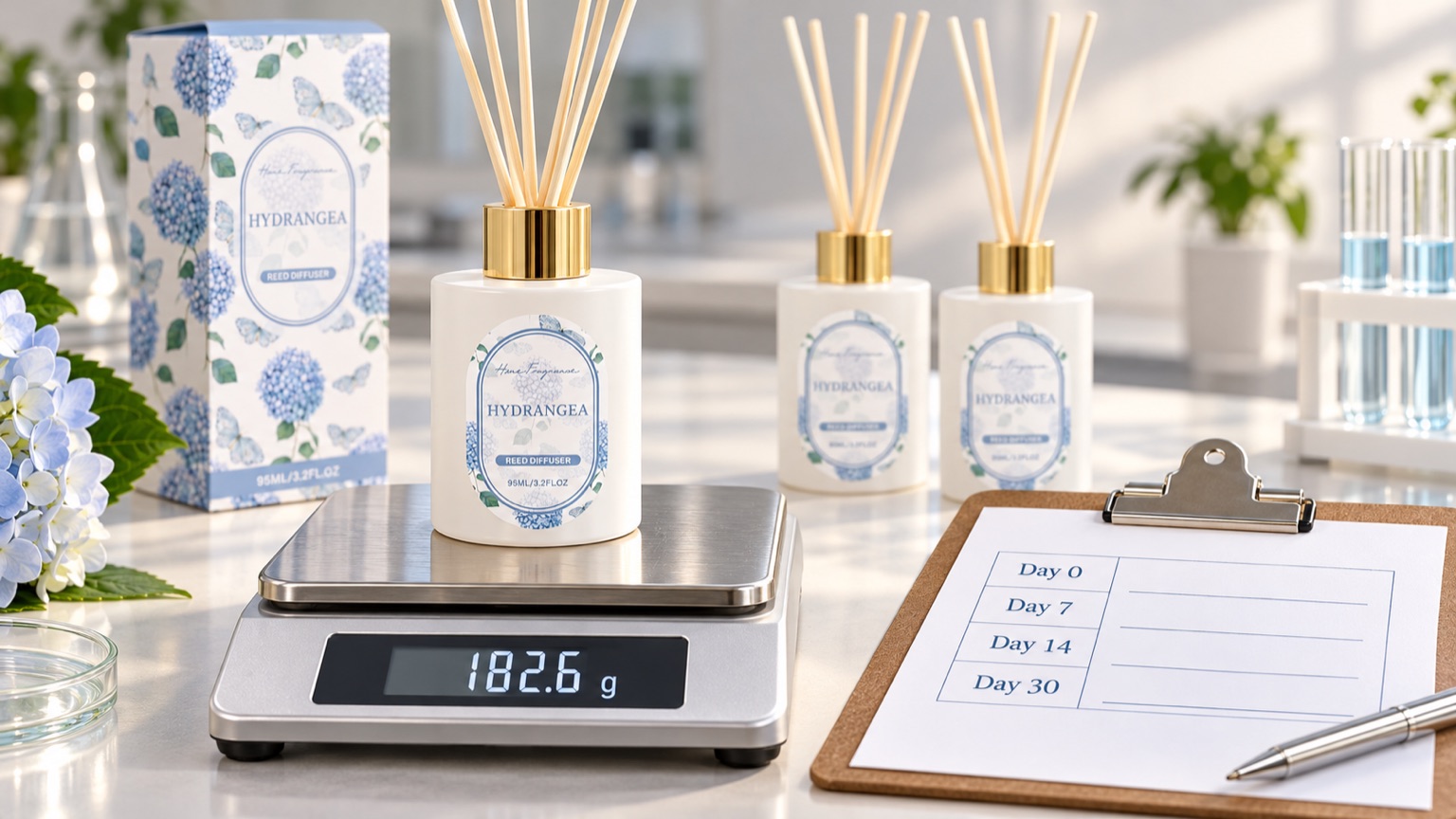
- Record weight on Day 0, 7, 14 and 30. Extend to Day 60 when the target life requires it.
- Use random codes and have at least three people score scent intensity.
- Check clarity, sediment, discoloration and reed wetting.
Calculate average daily loss = weight lost ÷ test days. If three identical samples behave differently, investigate the reeds, fill weight, bottle opening and test position.
Test the Base, Bottle and Reeds as One System
A narrow opening can compress the reeds. More reeds may strengthen the opening but accelerate liquid loss. Changing from rattan to fiber can alter wicking even when the diameter looks identical.
Test the actual formula against the cap, plug, liner, bottle coating and label adhesive. A water leak test cannot prove fragrance compatibility. Use production-equivalent liquid and inspect upright, side and inverted samples for leakage, liner swelling, label staining and coating damage.
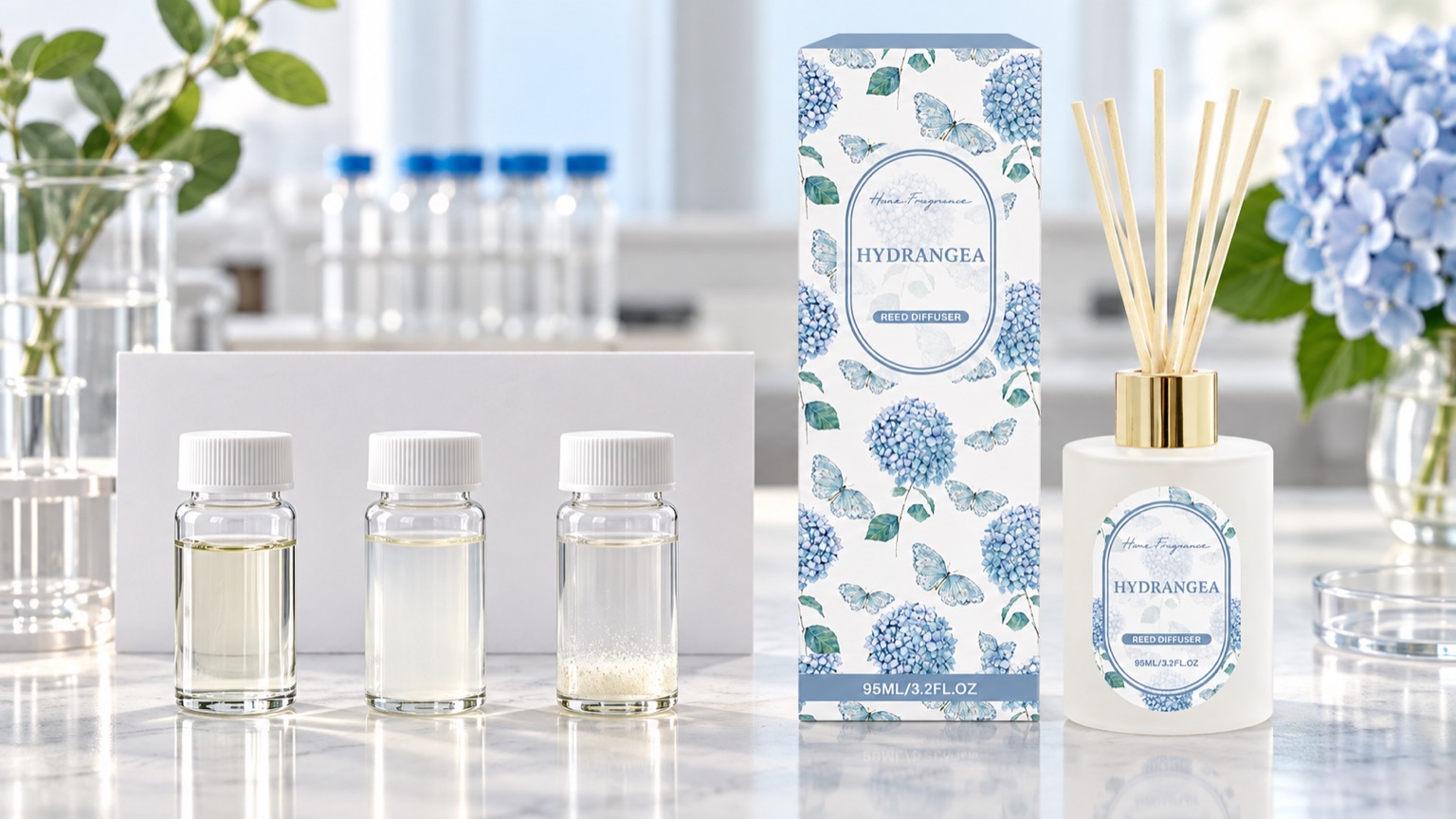
Freeze the Approved Configuration in the Golden Sample
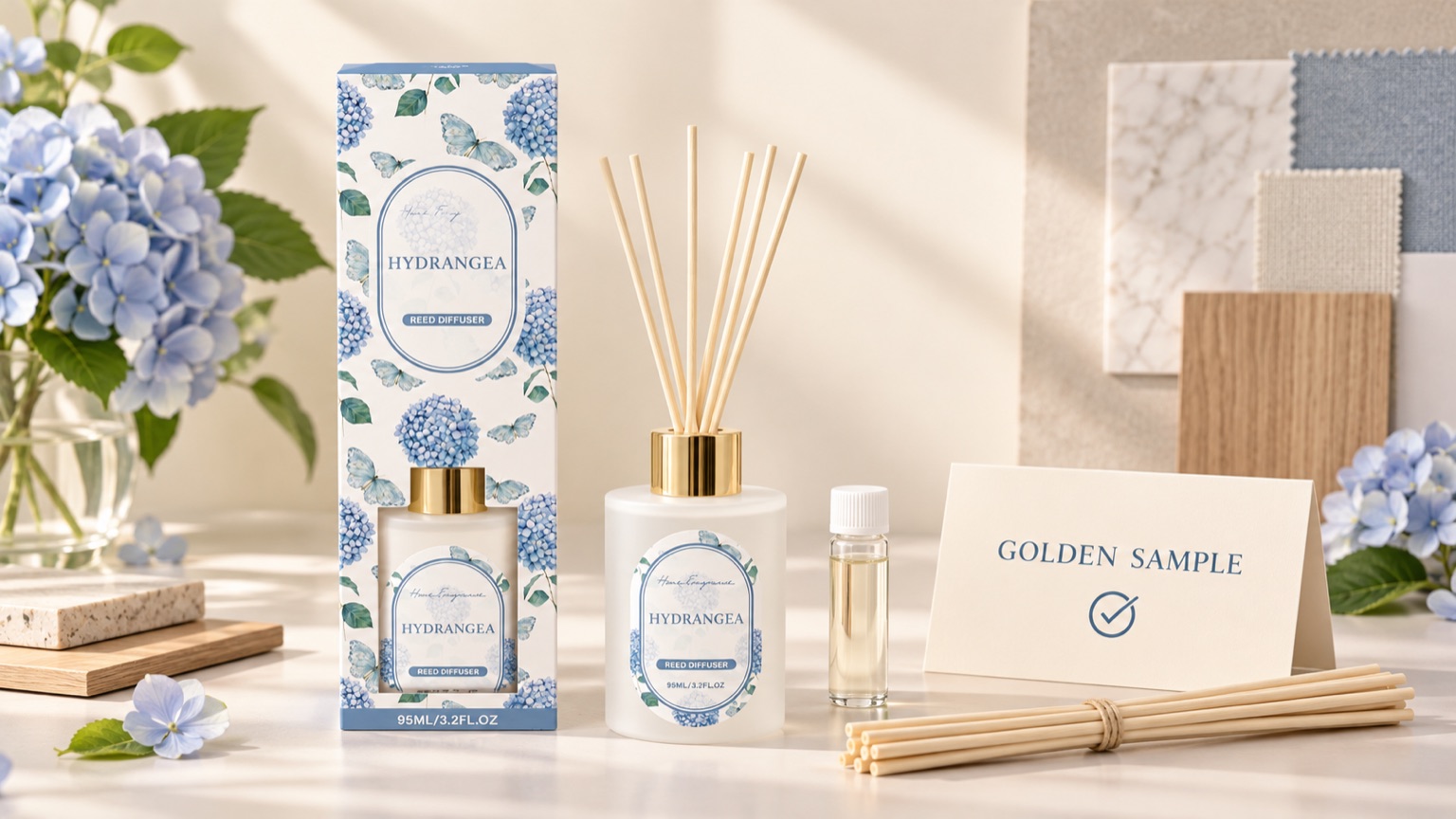
The Golden Sample should freeze the formula code, fill weight, bottle, closure and full reed specification. Changing one item later can change the result.
Keep the physical sample with the approved formula version, test record, artwork revision and packaging specification so bulk production has a complete reference.
What Documents Should Buyers Request?
Before bulk production, confirm:
- the exact trade name and grade of the base;
- SDS, TDS and batch CoA;
- density, viscosity, flash point, odor and color;
- finished-formula classification for the destination market;
- evidence supporting product claims;
- packaging compatibility results;
- the approved formula code and Golden Sample.
Do not request an “IFRA certificate” for DPG or another functional solvent. IFRA states that functional fragrance materials such as DPG do not receive an IFRA Certificate of Conformity. The certificate applies to fragrance mixtures for a stated end use and does not replace a safety assessment.
Frequently Asked Questions
Which reed diffuser base gives the strongest scent?
No base can guarantee the strongest scent by itself. Fragrance composition, viscosity, reed material, bottle opening, temperature and airflow all affect the result.
Is an alcohol-free diffuser base better?
It may support a specific brand claim or transport brief, but alcohol-free does not automatically mean stronger, longer lasting or safer. Test its complete performance and documentation.
Can the same base be used for every fragrance?
An approved base can be a useful collection platform, but every fragrance still needs clarity, stability, wicking and scent-performance checks.
The Final Takeaway
Choose the Scent Curve, Not the Strongest First Impression
The best reed diffuser base is not the one that smells strongest on Day 1. It is the one that keeps the fragrance clear, feeds the selected reeds and delivers the intended scent through the claimed product life.
If you are comparing bases, send UNION AURA your fragrance brief, bottle specification, reed size, target market and expected product life. We can prepare a focused comparison, evaluate the production-equivalent system and freeze the selected configuration into the approved Golden Sample.
Explore our reed diffuser collection, read our guides to reed diffuser oil and reed diffuser sticks, or learn more about our OEM and ODM development process.