
Buyers often ask which reed gives better scent throw: natural rattan or fiber.
Our usual answer is: do not start with the material. First tell us the bottle size, how easily the formula flows and how long the diffuser needs to last.
For a 100–200ml home diffuser where consistent color, stable production and easy repeat orders matter, we normally start by testing eight 4mm × 250mm fiber reeds. It is not a universal standard, but it is a useful first sample. It tells us more than testing a dozen combinations without a clear direction.
If the collection needs a natural, botanical or handmade look, rattan can be the better choice. Check straightness, moisture level and mold spots before approving it. The real question with a natural material is not whether the first sample looks good. It is whether the second and third batches will look the same.
In short:
Fiber reeds are easier to standardize; rattan gives a more natural appearance. Both can perform well, and both can fail.
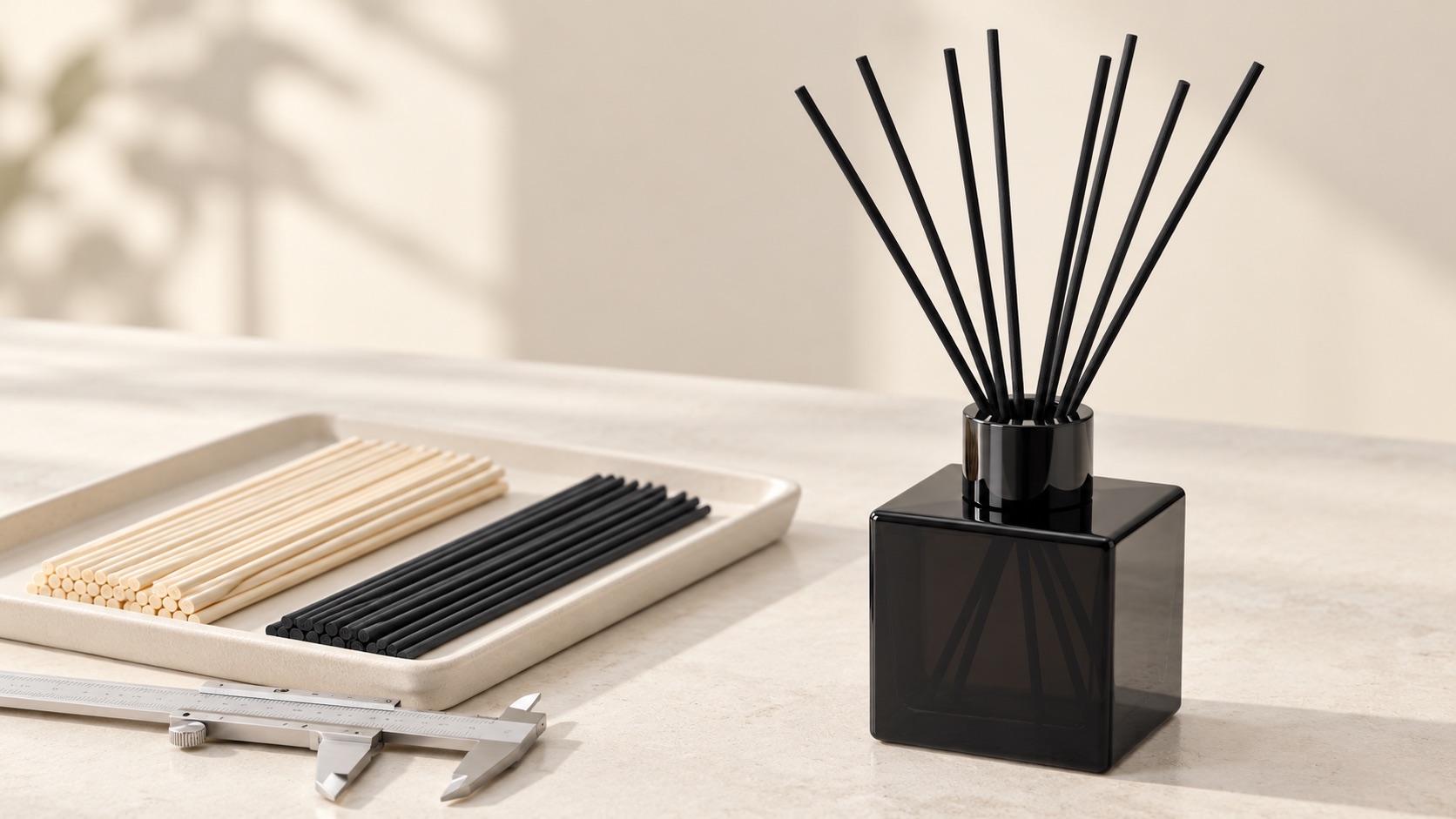
Choose by Product Direction First
| Product | Start With | Main Risk | First Test |
|---|---|---|---|
| 100–200ml home diffuser, modern look, standardized production | 8 fiber reeds, 4mm × 250mm | Color bleeding, blockage, high early consumption | 7-day color test and 30-day weight loss |
| Natural or botanical collection, smaller runs | 8–10 rattan reeds | Mold, bending and batch variation | Straightness, surface condition and initial wicking |
| Black or colored reeds | Soak in the final formula first | Fading, neck staining and liquid discoloration | 7-day soak and white-wipe test |
| Reed diffuser refill | Include a fresh set of reeds | Old reeds may clog or carry over fragrance | Compare old and new reeds |
| Gift set or e-commerce pack | Confirm how the reeds are secured | Bending, moisture and paper dust | Inspect straightness after drop testing |
What Is the Practical Difference Between Rattan and Fiber Reeds?
For consistent production, start with fiber reeds
Fiber reeds are easier to control in diameter, length and color. They usually suit modern packaging and collections that need a uniform appearance. Standard black, white or natural colors are also easier to move through sampling when the supplier holds stock.
We normally check two problems first:
- Will the color bleed? Some black reeds can stain the liquid, bottle neck or decorative collar in certain solvent systems.
- Will the reed slow down later? A sample may wick quickly during the first week, then develop a dry top and noticeably weaker scent after Day 14.
The advantage of fiber is not that it is always stronger. It is that its dimensions and appearance are easier to control. Scent performance still depends on how the reed works with the formula.
For a natural look, consider rattan
The texture, color variation and small differences between rattan reeds can be exactly what a botanical collection needs. The purchasing specification, however, cannot stop at “natural rattan, 4mm × 250mm.” It should also cover straightness, surface cleanliness, mold spots, diameter variation and moisture protection during storage.
A common production problem is that the development sample looks good, but part of the bulk batch arrives bent or develops spots after storage in a humid season. This may not stop every reed from wicking, but it affects packing efficiency and the customer’s first impression.
Unless the brand needs the visual story of a natural material, a standardized collection does not always benefit from the extra sorting work.
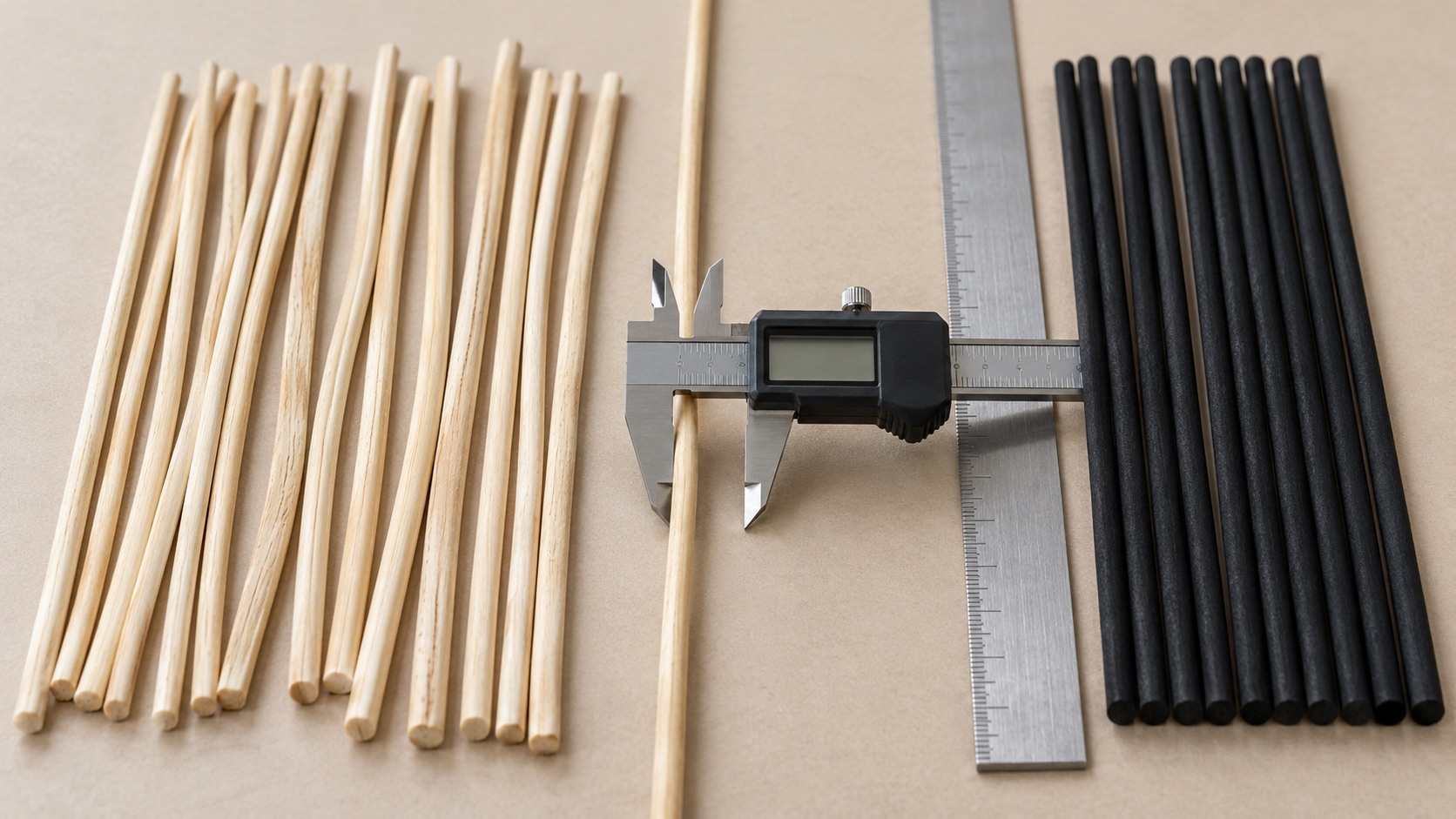
Weak Scent Throw Is Not Always a Reed Problem
1. The formula does not travel well through the reed
The same reed can behave very differently when the fragrance changes. Viscosity, solvent system and fragrance composition all affect wicking and evaporation. Do not approve a complete collection using only the easiest formula.
We prefer to start with two formulas: one that wicks easily and one that moves more slowly through the reed. If the same reed remains stable in both, it is a better candidate for the wider collection.
2. The bottle neck holds the reeds too tightly
A smaller neck is not always better. When eight reeds are packed tightly together, their contact and airflow change. A decorative collar with a tight inner opening may also scrape the coating from a black reed.
During sampling, record the bottle-neck diameter, the collar opening and how the reeds actually sit in the bottle. If the bottle or collar changes, do not assume the original reed count will still work.
3. Adding more reeds can shorten product life
When a diffuser smells weak, the first reaction is often to move from eight reeds to ten. That may improve early scent throw, but it can also increase consumption and leave the second half of the product noticeably weaker.
If eight reeds are not enough, first check whether the formula is wicking slowly, the fragrance itself does not project strongly, or the test room is too large. Adding reeds before finding the cause often delays the problem rather than solving it.
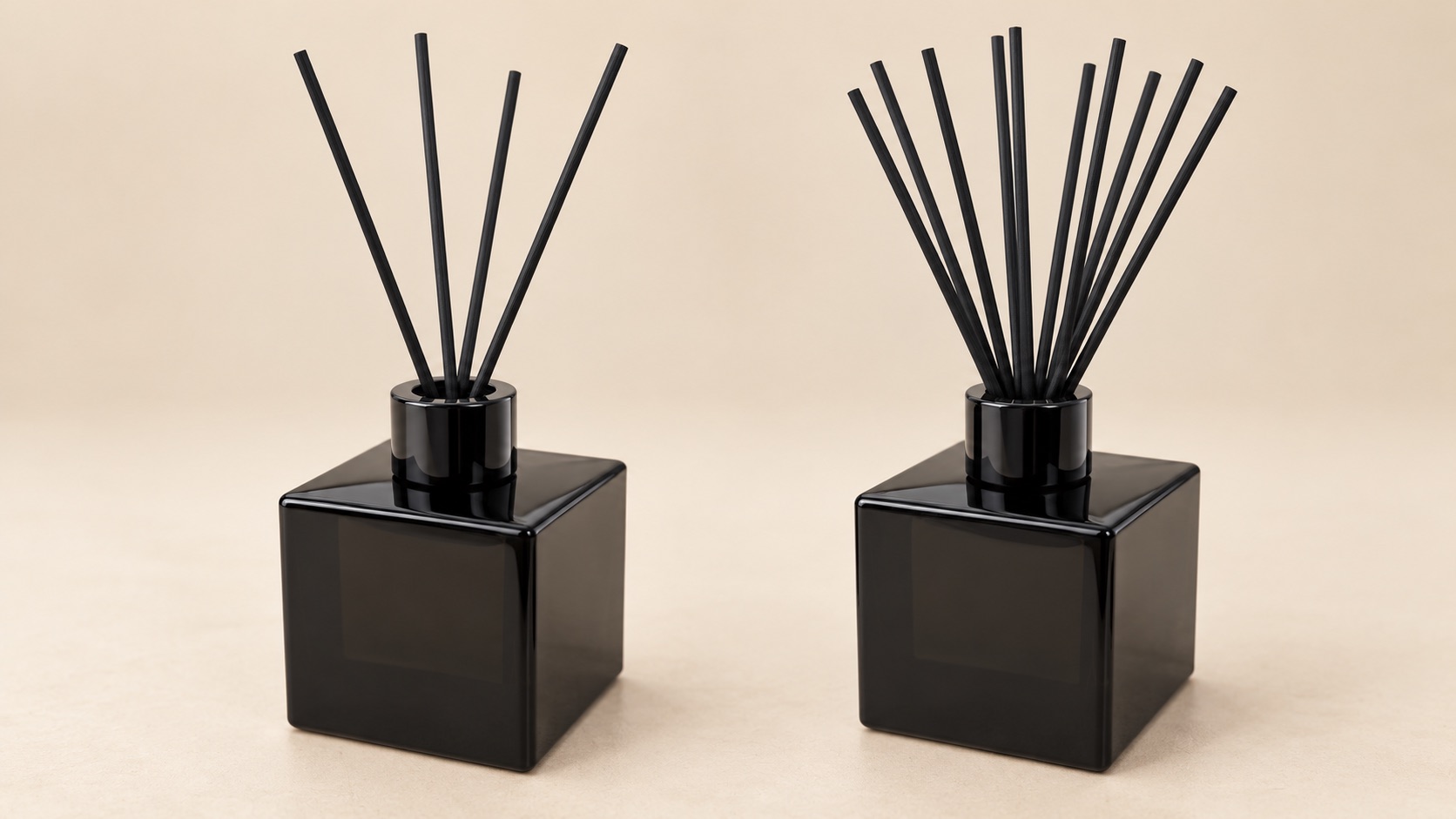
4. The samples are tested in different positions
A windowsill, an air-conditioning vent and the back of a shelf are not comparable test locations. Research has shown that temperature and diffuser position can materially affect VOC emissions and their distribution indoors. Test groups should therefore be kept under similar conditions and rotated between positions.1
A Practical 30-Day Reed Test
Routine product development does not need to begin with complex laboratory equipment. Start with four groups: Rattan A, Rattan B, Fiber A and Fiber B. Prepare three units per group. Use the same bottle, formula, fill weight and reed length throughout.
Record the weight on Day 0, 7, 14 and 30. Ask at least three people to assess scent using random sample codes. Do not flip the reeds during the basic test. If the product instructions tell consumers to flip them, run that as a separate group.
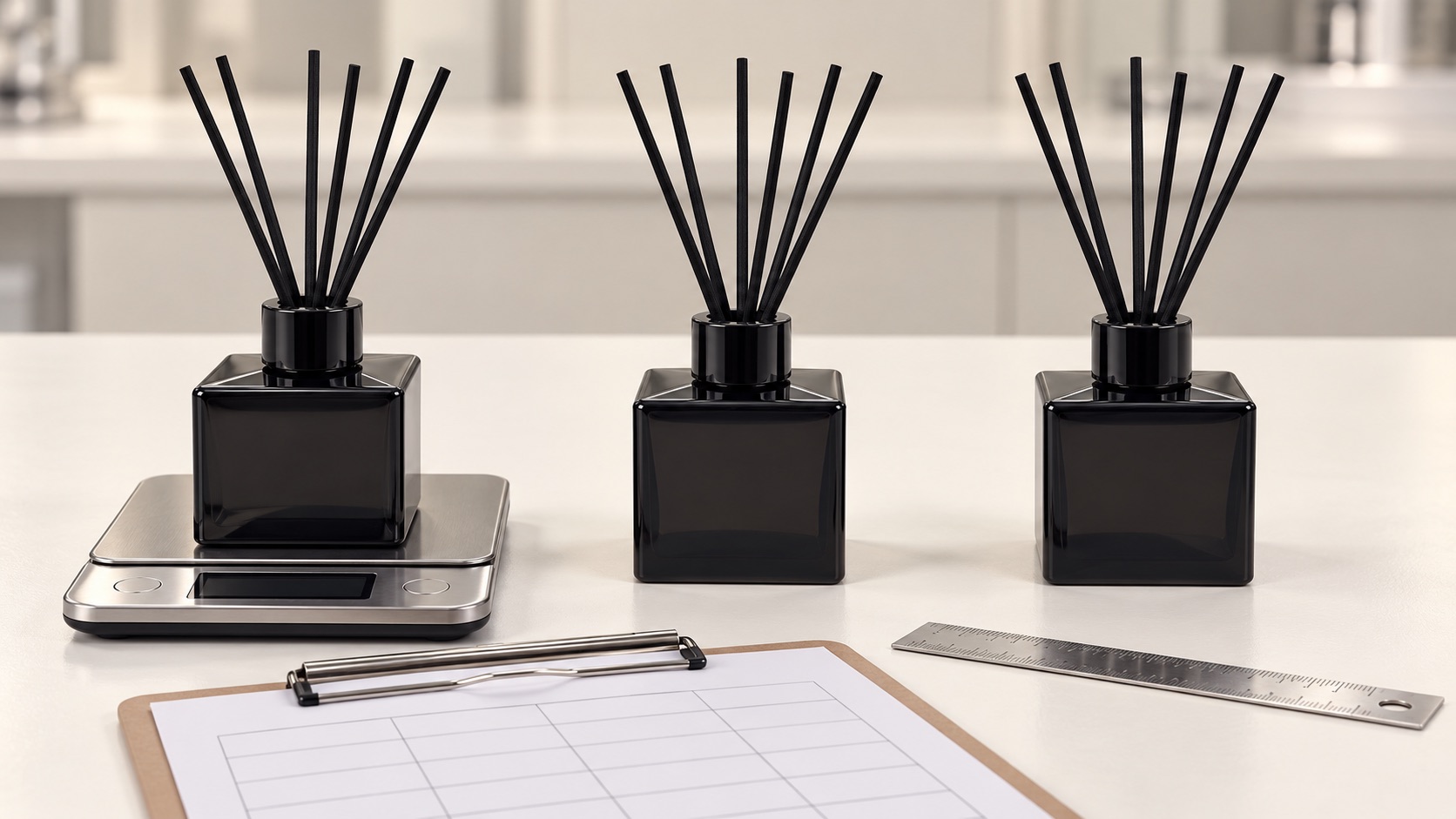
Focus on three points:
- Is consumption too high during the first week? A strong launch does not make a better diffuser if it cuts the intended product life.
- Does performance fall sharply after Day 14? Record dry reed tops, blockage or a sudden loss of scent.
- Do the three matching units behave alike? A good average can hide one unit that is far outside the group—exactly the kind of variation that becomes expensive in bulk production.
Daily consumption does not need a complicated formula. Divide the weight lost during each stage by the number of days. For a buyer, the important comparison is the change between Day 0–7 and Day 15–30, not only the 30-day average.
Common Reed Purchasing Mistakes
Approving black reeds by appearance alone
Soak the reeds in the final formula for seven days. Check whether the liquid changes color, then wipe the wet section with a white lint-free cloth. Inspect the bottle neck, decorative collar and nearby label area. If the sample passes, continue with the 30-day test.
Measuring rattan diameter but ignoring storage condition
Two reeds sold as 4mm can still differ in thickness, straightness and surface condition. Do not take every inspection sample from the top of one pack. Pull reeds from different packs and positions. In humid storage conditions, moisture protection and stock rotation matter as much as the dimension written on the specification.
Selling refills without replacement reeds
Used reeds may contain dust, blockage or traces of the previous fragrance. Saving a few reeds in a reed diffuser refill can make the customer think the refill oil itself does not work. When cost allows, include a fresh set. At minimum, state clearly on the label that replacing the reeds is recommended.
Comparing unit price instead of cost per diffuser
Compare the actual cost per finished diffuser, including the number of reeds, sorting loss, custom color, packing and rejection rate. A lower price per rattan reed does not guarantee a lower cost per set if more pieces are rejected for bending or appearance.
Confirming a custom color too late
Standard colors and custom colors do not carry the same MOQ or lead time. A custom color also needs time for color matching, soaking and migration testing. When the launch schedule is tight, an already approved standard color is usually safer than cutting the test period short.
Ten Points to Confirm Before the Purchase Order
- Reed material and supplier material code
- Diameter, length and permitted tolerances
- Quantity per diffuser and exposed reed length
- Final formula, bottle and bottle-neck diameter
- Seven-day color-migration result
- Weight records from Day 0, 7, 14 and 30
- Variation between the three matching units
- Pack quantity and protection against bending, dust and moisture
- MOQ, stock availability, sample time and production lead time
- Golden Sample, retained batch sample and material-change notification
One more common mistake: an IFRA Certificate should be requested from the fragrance supplier, not the reed supplier. The reed supplier should provide information relevant to the reed material, colorant and destination-market requirements.
Frequently Asked Questions
How many reeds should a 100–200ml diffuser use?
If there is no previous test data, start with eight 4mm × 250mm fiber reeds. Adjust the count after reviewing consumption and scent on Day 7 and Day 14. Do not start with a large reed count simply to chase stronger early output.
Are rattan reeds always weaker than fiber reeds?
No. Material name alone does not determine scent throw. The more common concern with rattan is batch consistency and appearance sorting—not an automatic lack of performance.
Do black diffuser reeds always bleed?
No, but every black or colored reed should be soaked in the final formula. A test in water is not useful when the actual solvent system is different.
How often should diffuser reeds be replaced?
For consumer guidance, one to three months or every time the diffuser is refilled is a reasonable reference point. Final label instructions should follow the tested life of the actual formula and reed combination.
Can diffuser reeds be reused?
We do not recommend reusing reeds across fragrances. Used reeds retain the previous liquid and may already be partially blocked. Even when refilling the same fragrance, fresh reeds usually give a more reliable restart.
The Final Decision
Choose the Product Direction, Then Test the Complete System
For a modern collection that needs reliable repeat orders, test fiber reeds first. If the brand needs the appearance of a natural material, add rattan to the comparison. The first round does not need every possible combination: choose two material suppliers, prepare three units per option and complete the 30-day test.
If you are selecting reeds for a new reed diffuser, send us the bottle, formula and target product life. Through our OEM/ODM development process, we can run the comparison above, then lock the reed specification, packing method and test record into the Golden Sample—instead of leaving the purchase order with only “eight black reeds.”
References
- Zhang et al. (2024), Emissions of volatile organic compounds from reed diffusers in indoor environments, Cell Reports Physical Science, 5(8), 102142.
- IFRA: Understanding the Standards
- ECHA: REACH Candidate List of SVHC