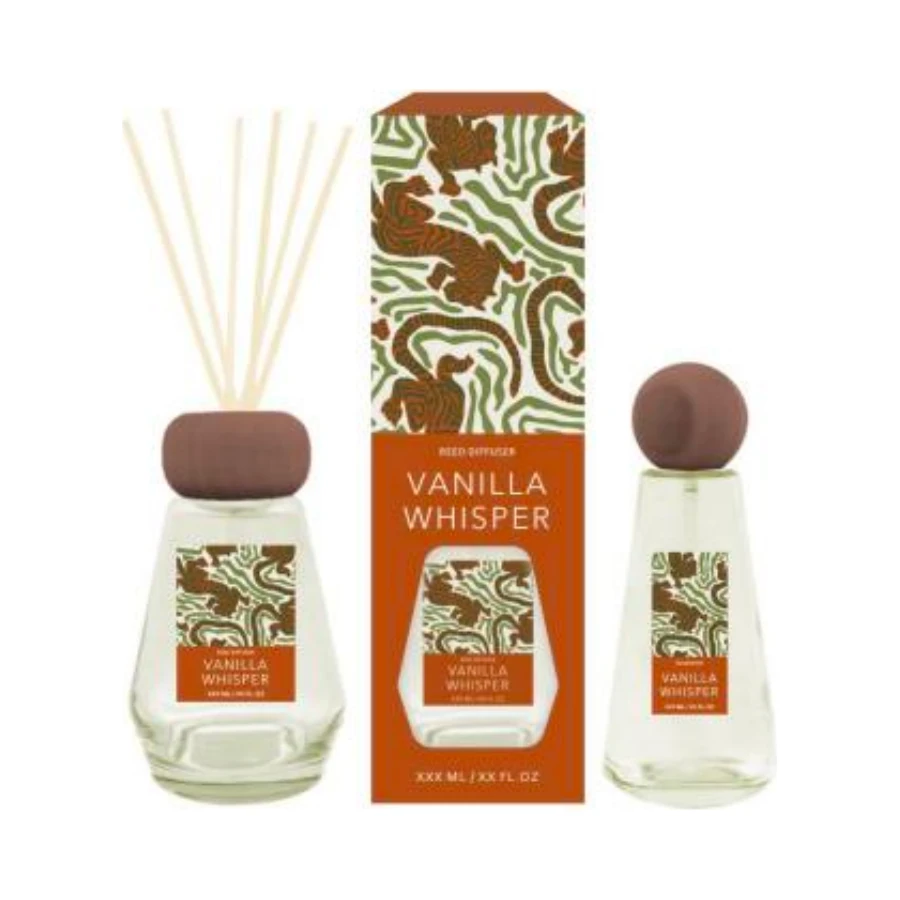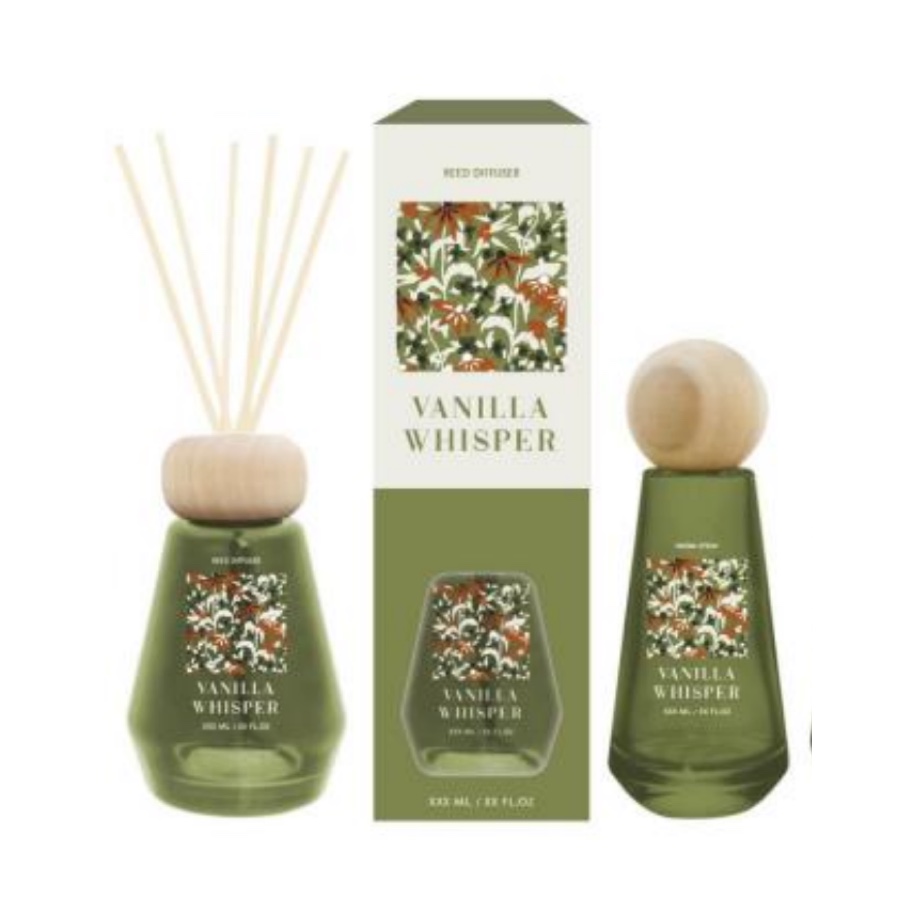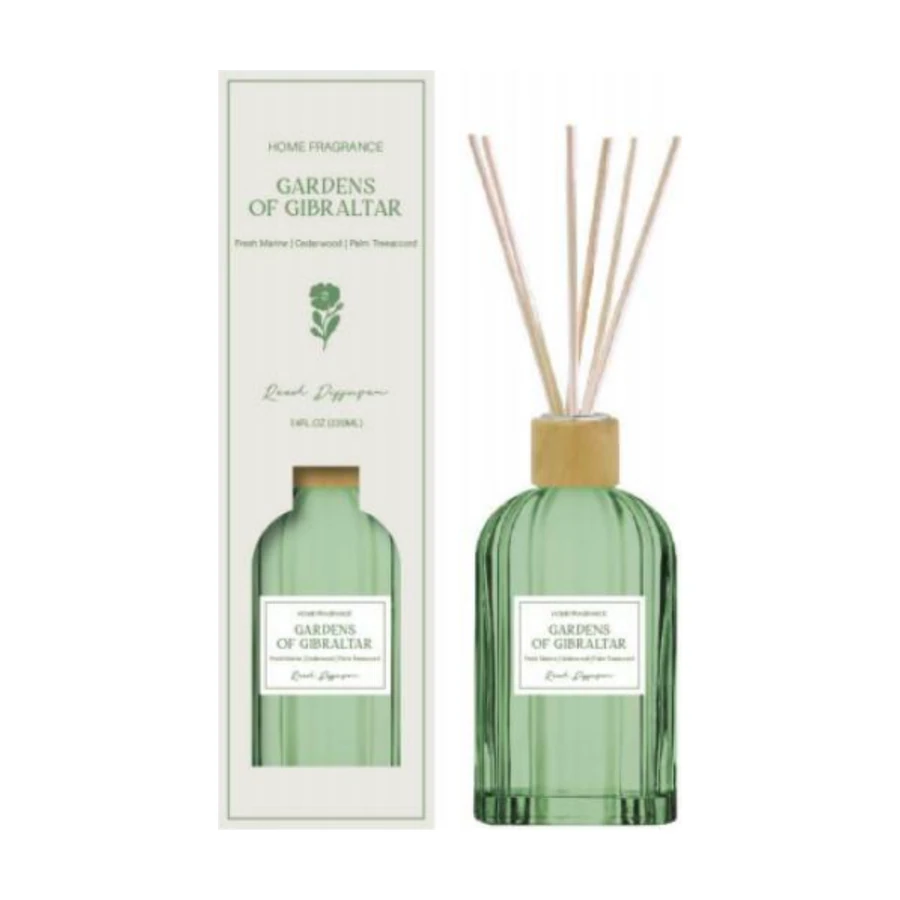
For retailers, hotels and home fragrance brands, choosing a reed diffuser involves more than selecting a favorite fragrance and an attractive bottle.
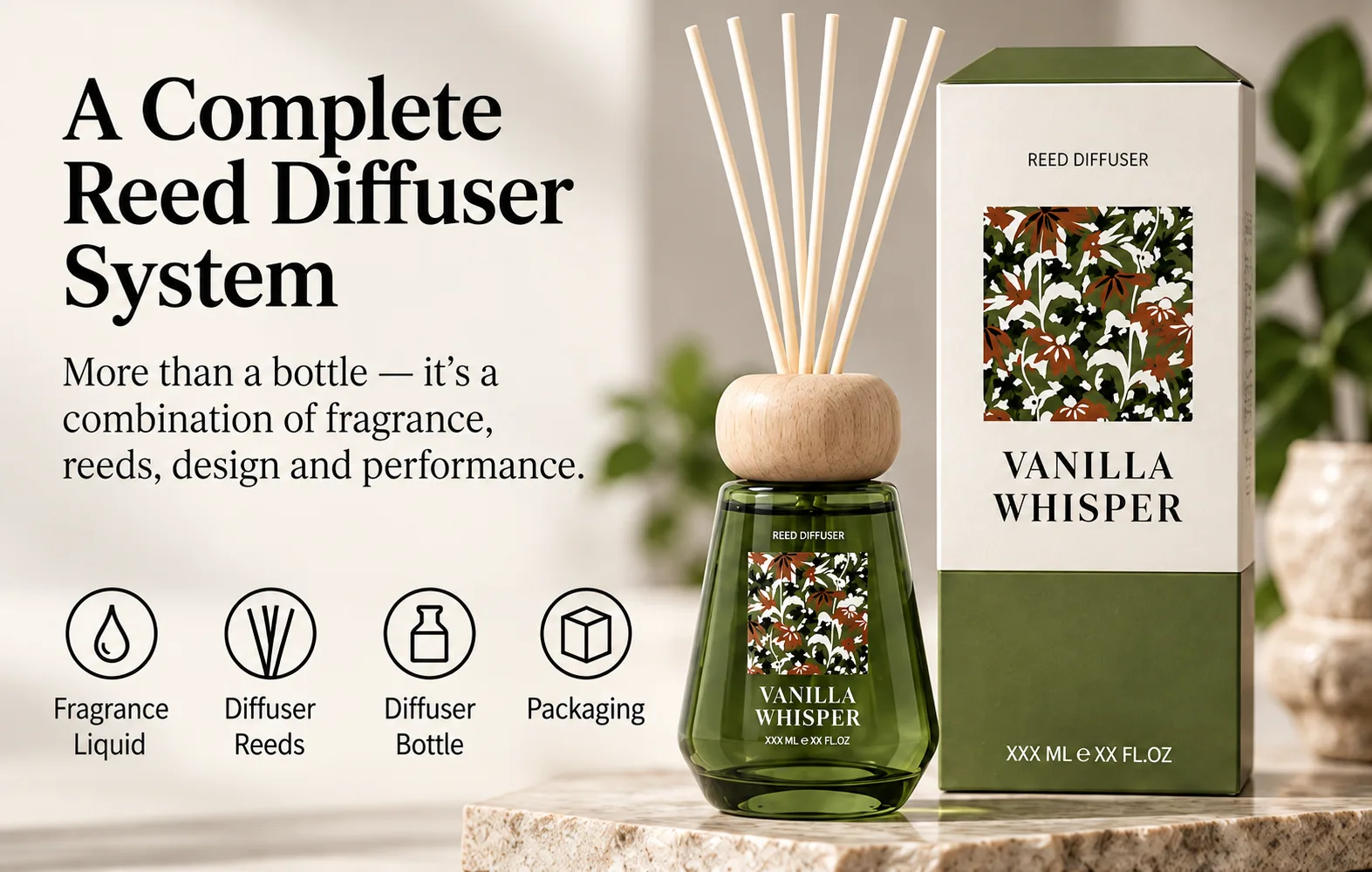
A high quality reed diffuser is a complete fragrance system. The reed diffuser oil, diffuser reeds, diffuser bottle, fragrance liquid, bottle opening and room environment all influence how the product performs.
Understanding these variables helps buyers compare samples using measurable criteria rather than appearance alone.
1. Start With the Reed Diffuser Oil
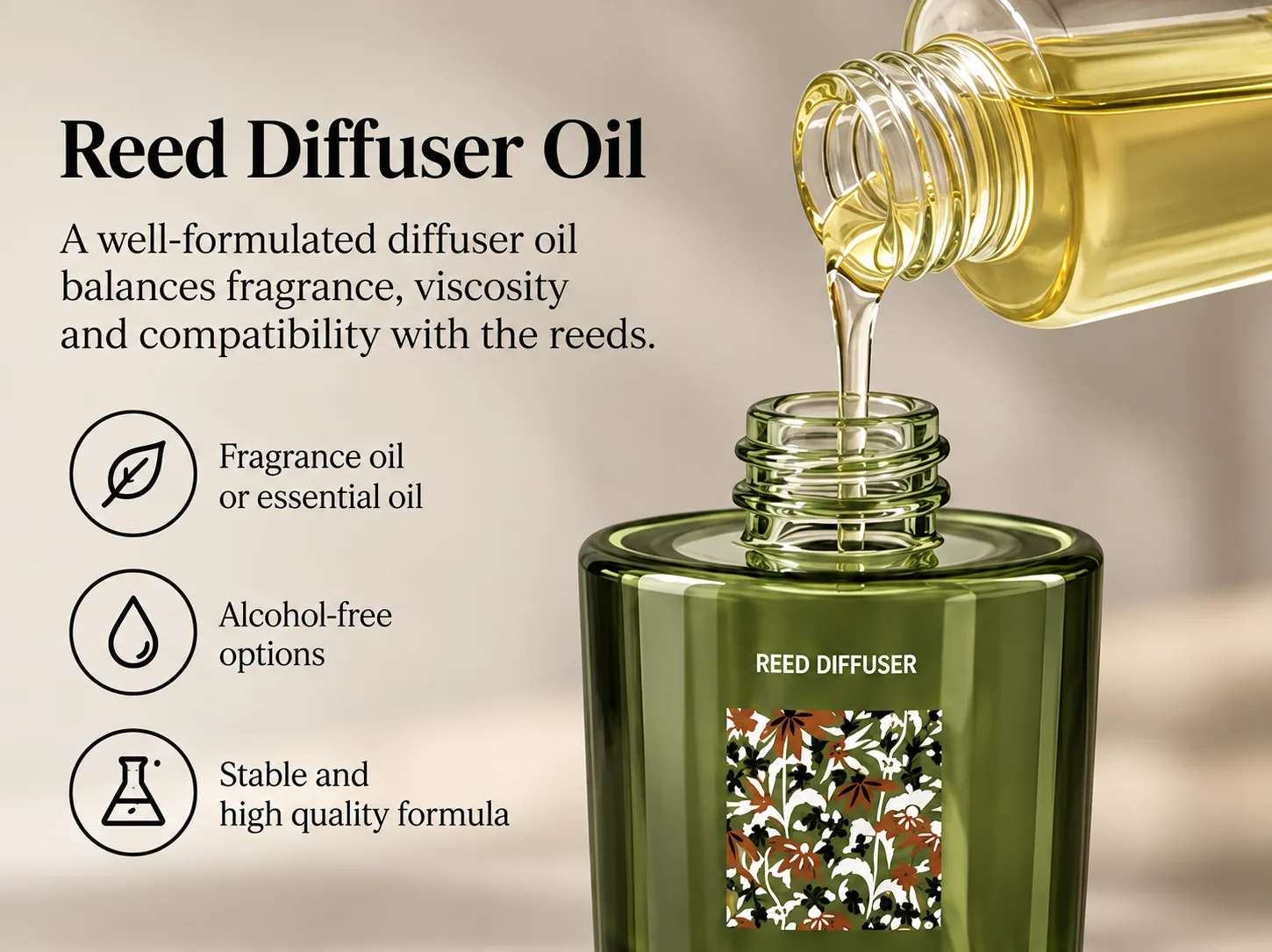
The first specification to examine is the liquid formula.
Reed diffuser oil normally contains a carrier base combined with fragrance oil, essential-oil components, or both.
An essential oil is not automatically a finished diffuser formula. The complete liquid must have suitable viscosity, volatility and compatibility with the selected reeds.
The same applies to alcohol-free formulas. “Alcohol free” describes the carrier approach; it does not by itself demonstrate stronger scent or longer product life.
Most importantly:
A higher fragrance load does not automatically produce a stronger scent.
CandleScience permits fragrance loads up to 25% for many diffuser-approved fragrances but specifically notes that adding more fragrance does not necessarily increase scent strength.
One supplier formulation comparison illustrates the effect:
| Fragrance Load | Day-14 Scent Score | 14-Day Weight Loss | Reed Flow |
|---|---|---|---|
| 15% | 2/5 | 10.2 g | Good |
| 20% | 4/5 | 11.1 g | Good |
| 25% | 4/5 | 10.6 g | Slower |
In that specific test, increasing the fragrance load from 20% to 25% produced no improvement in the recorded scent score, while reed flow became slower.
Source: Xuelei Fragrance formulation test. Supplier-generated comparative data; not a universal industry benchmark.
For sourcing, therefore, ask for the tested finished formula, not simply the highest fragrance percentage.
2. Specify the Diffuser Reeds
The diffuser reeds are functional components, not decorative accessories.
Reed material, diameter, length and count affect how efficiently the liquid travels and how much wet surface is exposed to the air.
A controlled supplier comparison tested rattan and fiber reeds using the same:
- 200 mL diffuser
- 20% fragrance load
- 8 reeds
- 25 cm reed length
- 22°C
- 50% relative humidity
The reported results were:
| Test | Rattan Reeds | Fiber Reeds |
|---|---|---|
| Initial wicking | 4–8 h | 1–3 h |
| 24-hour scent score | 5–6/10 | 7–8/10 |
| Day-30 scent score | 5–6/10 | 6–7/10 |
Source: Aromiso controlled supplier comparison. These results apply to the tested configuration and are not a universal rattan-versus-fiber standard.
The important conclusion for buyers is not that one material is always superior.
It is that suppliers should compare reeds using controlled conditions.
If you change the fragrance liquid, reed count and bottle at the same time, the test tells you very little about which variable improved the fragrance experience.
3. Don't Choose a Diffuser Bottle by Appearance Alone
Packaging matters—particularly for luxury reed diffusers—but bottle design also affects function.
The final specification should include:
Bottle capacity + neck opening + fill weight + reed diameter + reed length + reed count + liquid formula
A decorative glass bottle may look ideal for a premium collection, but changing its neck geometry or reed configuration can change evaporation behavior.
This is why the approved production sample should use the exact bottle, formula and reeds intended for mass production.
For a retail collection, this also makes performance more consistent across multiple home fragrance diffusers.
4. Test How Long Reed Diffusers Actually Last
Buyers frequently ask how long do reed diffusers last?
Do not accept an unsupported statement such as “maybe lasts 90 days.”
Measure it.
A simple measurement:
Starting liquid weight = 100.0 g
Liquid remaining after 30 days = 67.0 g
Therefore:
30-day consumption = 33.0 g
and:
Average consumption = 1.10 g/day
If the product is intended for 200 hotel rooms, that number becomes useful for estimating replenishment frequency, inventory and operating cost.
The test record should include at least:
Day 0 → Day 7 → Day 14 → Day 30
along with room temperature, reed configuration and placement.
Also record whether staff flip the reeds, because flipping increases exposed scented-oil surface and can change consumption.
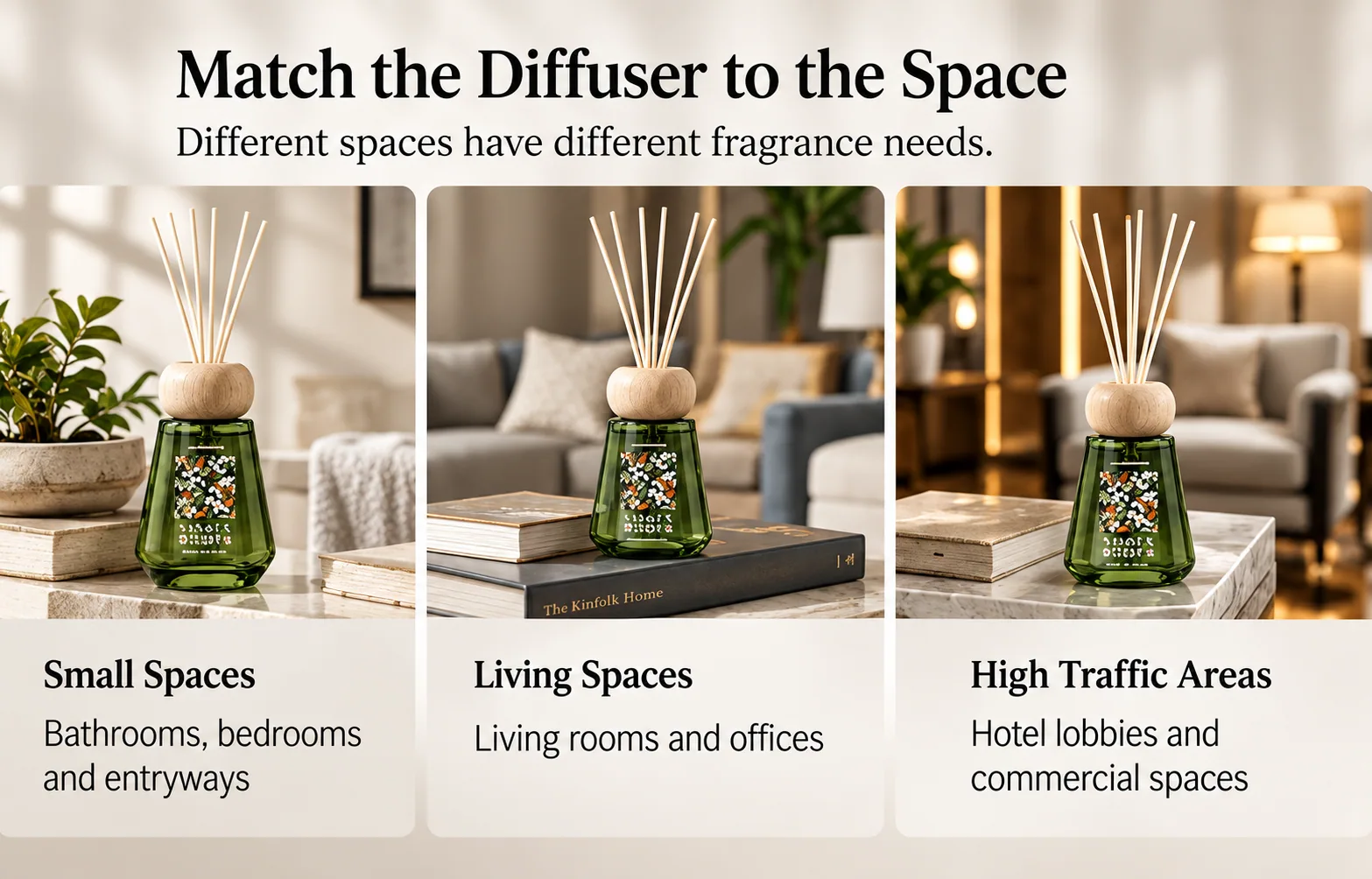
5. Match the Diffuser to the Space
A diffuser designed for small spaces should not automatically be specified for a hotel lobby.
Room volume, airflow and placement influence how effectively a diffuser can disperse scent.
In high traffic areas, stronger air movement can change both fragrance distribution and evaporation. The 2024 peer-reviewed chamber study also found that diffuser position affected how emitted compounds were distributed indoors.
This makes real-room testing especially important for hospitality buyers.
Rather than asking only:
“Does this diffuser make the space smell stronger?”
Evaluate:
Scent intensity + liquid consumption + placement + maintenance + room size
For large commercial spaces, multiple fragrance points may also perform differently from simply increasing the size of one diffuser.
6. Run a Pilot Before Placing a Bulk Order
For private-label retail or hospitality projects, test the final product before mass production.
Keep these variables fixed:
- Reed diffuser oil
- Bottle and fill weight
- Reed material
- Reed diameter and count
- Placement
- Test duration
Then record:
scent performance, liquid loss, reed condition, leakage, bottle stability and packaging performance.
If candles and reed diffusers will be sold as one fragrance collection, also evaluate whether the candles and reed diffusers deliver a recognizable fragrance profile across both formats. A candle and a passive diffuser use different fragrance-release mechanisms, so identical fragrance names do not guarantee an identical sensory result.
What Should Buyers Ask a Reed Diffuser Supplier?
Before approving a product, ask for:
- Fragrance load and carrier/base type
- Fragrance oil specification
- Alcohol-free options, if required
- Reed material, diameter, length and count
- Bottle capacity and fill weight
- Stability-test results
- Consumption/evaporation test data
- Leakage and packaging test information
- Applicable safety and compliance documentation
- A final production-equivalent sample
These specifications make it much easier to distinguish a visually attractive air freshener from a professionally developed home fragrance product.
Buyer's Summary
Evaluate the Complete Fragrance System
A high-quality reed diffuser works when its fragrance liquid, reeds, bottle and intended environment have been tested together.
For retail and hospitality buyers, that system-level approach provides a stronger foundation for consistent performance, controlled replenishment and a better fragrance experience.
UNION AURA develops custom reed diffuser systems for retail, home fragrance and hospitality projects, including fragrance development, reed selection, bottles, packaging, alcohol-free options, sampling and production.
For a new project, send us your target market, bottle capacity, expected quantity, fragrance direction and application environment to start sample development.
References
CandleScience. How to Make Reed Diffusers.
Xuelei Fragrance. Reed Diffuser Base and Fragrance Load Formulation Testing.
Aromiso. Rattan Reeds vs. Fiber Reeds: Performance and Cost Compared.