
Yes, essential oils can be used in a reed diffuser—but not as a direct one-for-one replacement for a finished diffuser fragrance.
For commercial products, an essential oil is a fragrance raw material. It still needs a compatible diffuser base, a controlled fragrance load and testing in the final bottle-and-reed system. Used on its own, it may wick poorly, evaporate unevenly, oxidize or change color long before the product reaches its intended shelf life.
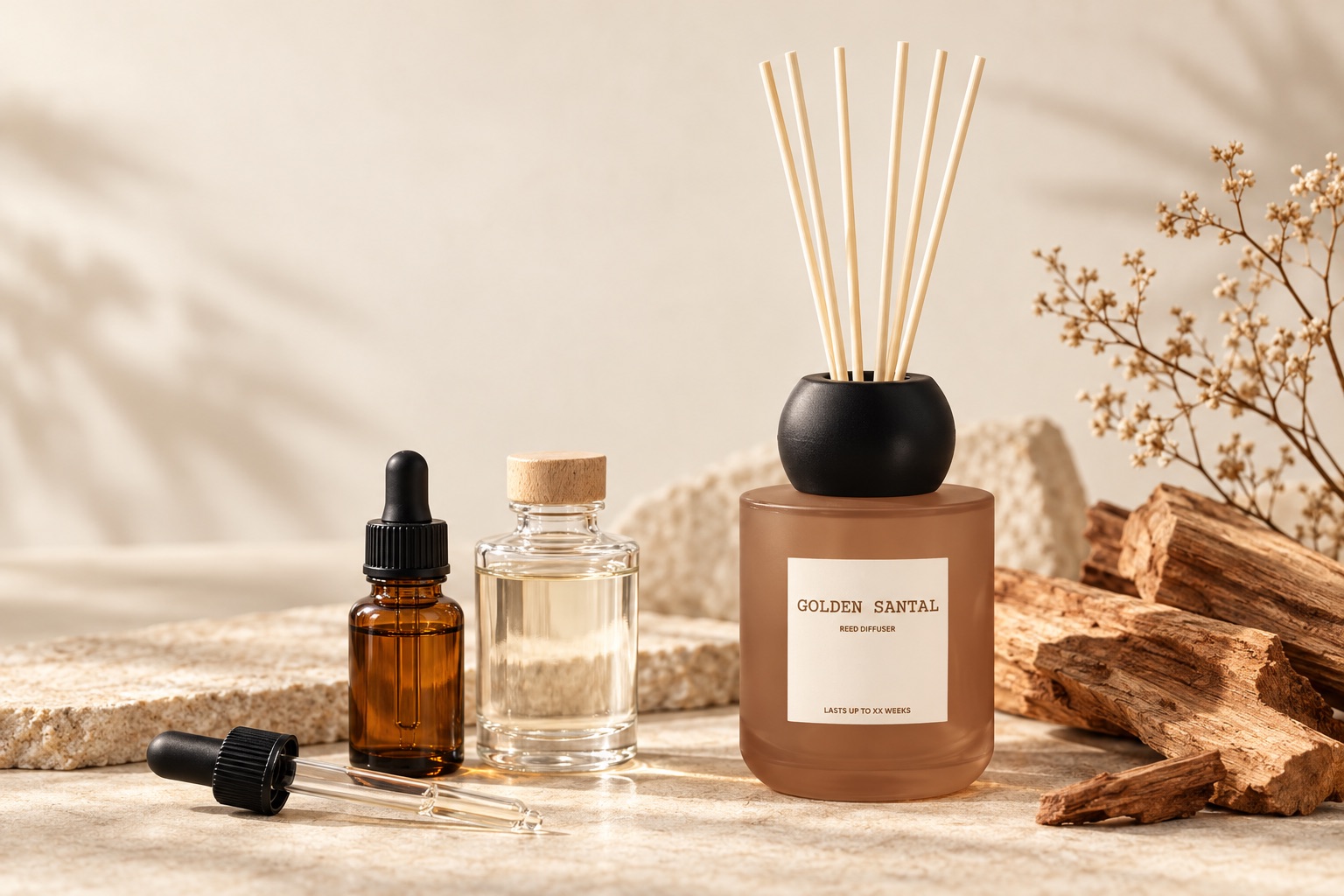
Can You Put Pure Essential Oils Directly in a Reed Diffuser?
We do not recommend it.
Essential oils vary widely in viscosity, volatility, color and chemical composition. A citrus oil and a heavier woody or resinous material will not travel through the same reeds at the same rate. Even when the liquid reaches the top, its lighter components may disappear first, leaving the scent noticeably flatter later in the product life.
For a retail product, the better approach is to use essential oils within a formula developed for passive diffusion.
Essential Oil Is Not the Same as a Finished Fragrance
The usual comparison—essential oil is natural, fragrance oil is synthetic—is too simple. A formulated fragrance may contain essential oils, natural extracts and aroma molecules selected for the required scent and application.
| What to Compare | Essential Oil | Formulated Fragrance |
|---|---|---|
| Composition | A natural complex substance or blend of natural oils | A mixture designed for a target scent and application |
| Batch consistency | Can vary with origin, season and extraction | Usually easier to control |
| Scent range | Limited to available natural materials | Can build a broader and more stable profile |
| Main development risk | Oxidation, color and natural variation | Compatibility and application level |
| Cost | Some oils are costly and price-sensitive | Easier to develop against a target cost |
For most 100–200 ml retail collections, where repeatability matters, our default recommendation is a fragrance developed for reed diffusers, with selected essential oils included where they support the scent story. A 100% essential-oil direction makes more sense when the brand position justifies the additional cost, testing and batch control.
Why Do Essential Oils Perform Differently?
Essential oils are natural complex substances. Their composition can change with the plant part, growing region, harvest and extraction method. Two materials sold under the same familiar plant name may therefore differ in odor, color and stability.
- Citrus materials often give a bright opening but need close attention to oxidation and light stability.
- Darker natural materials may change the color of the liquid or label area.
- Heavier materials can alter liquid flow and reed saturation.
- A blend that remains clear at room temperature may become cloudy after cold storage.
Check each production lot against the approved sample.
Does More Essential Oil Make the Diffuser Stronger?
Not necessarily.
Increasing the essential-oil percentage can raise cost without increasing the amount of scent released. If the revised liquid moves more slowly through the reeds, less material reaches the evaporation surface.
Test several loads around the intended formula using the same bottle, fill weight, reeds and environment. For each configuration, use at least three samples and record:
- weight on Day 0, 7, 14, 30 and 60;
- weight-loss trend and blind scent score;
- clarity, sediment, color and odor change;
- reed saturation;
- staining or damage around the bottle neck and closure.
If the three samples behave very differently, investigate leakage, filling variation or inconsistent reeds before changing the fragrance load.
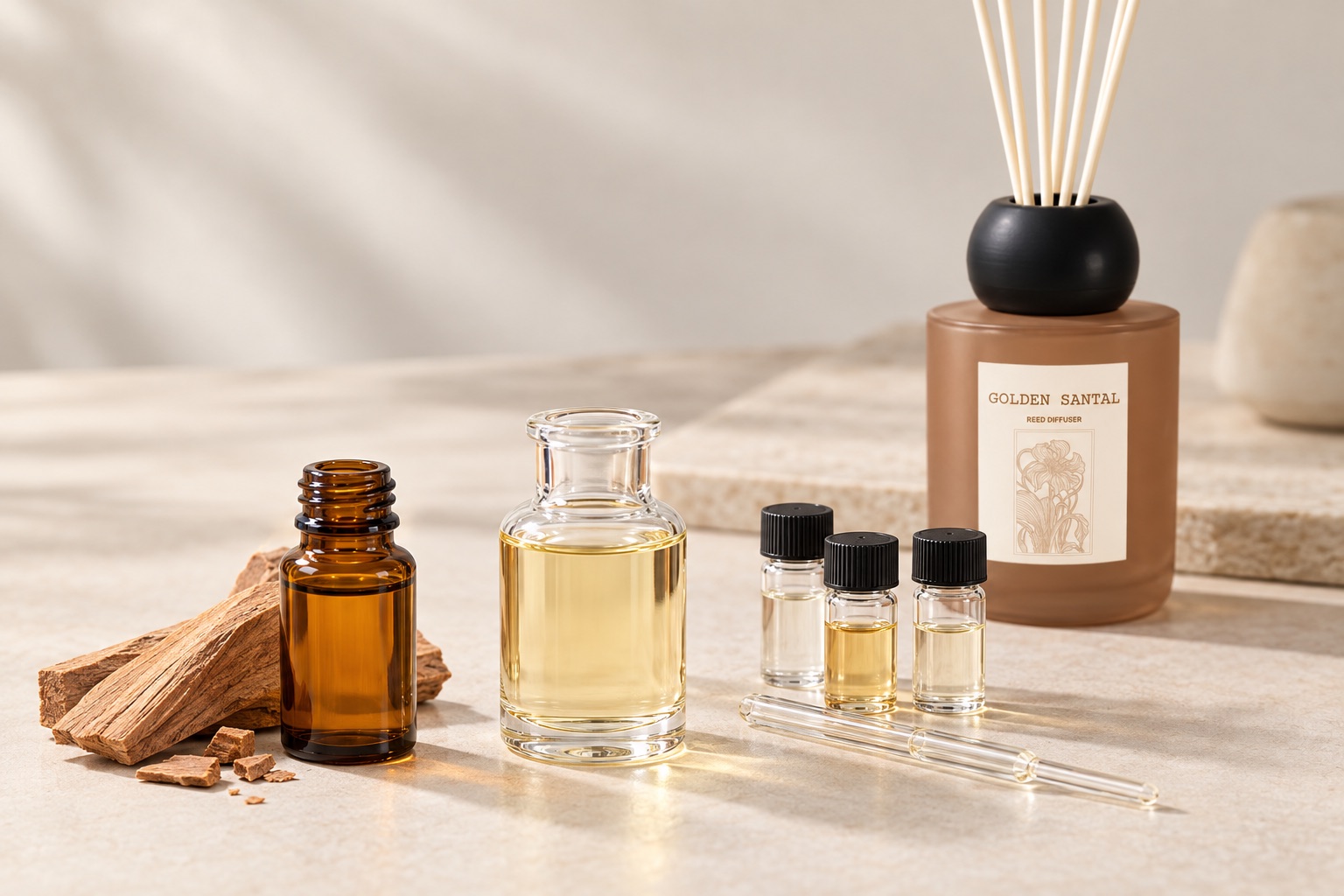
What Base Should Be Used with Essential Oils?
Use a base developed for reed diffusers and verified with the selected essential-oil blend.
Ordinary skincare carrier oils such as olive, almond or standard coconut oil should not be treated as automatic substitutes. They may be too slow-moving for reliable diffusion. Water should not be added unless the entire system has been designed for it, including solubility, preservation and performance.
Alcohol-based and alcohol-free bases can both work. Choose according to the target scent throw, product life, sales market, transport needs and brand claims.
Are Essential Oil Reed Diffusers Safer?
Natural origin does not remove concentration limits, sensitization concerns, ingestion hazards or finished-product labelling requirements.
Essential oils can naturally contain constituents covered by IFRA restrictions. IFRA explains that individual raw materials do not normally receive an IFRA Certificate of Conformity. The raw-material supplier can instead communicate conformity with the relevant Standard. A Certificate of Conformity is generally prepared by the fragrance-mixture manufacturer for the intended use.
That document still does not replace the safety assessment or regulatory classification of the finished diffuser.
Request the SDS, raw-material identity and traceability, relevant constituent data, and documentation for the completed fragrance blend. Then classify and label the final formula for its target market.
Avoid broad claims such as non-toxic, chemical-free or pet-safe unless the exact claim has suitable technical and legal support. The product should also be kept out of reach of children and pets, regardless of whether its scent comes from essential oils or a formulated fragrance.
What Should Buyers Confirm Before Approval?
Before approving an essential-oil reed diffuser, confirm:
- Botanical identity, plant part and extraction method.
- Supplier and batch traceability.
- SDS and applicable composition information.
- IFRA conformity information for the raw materials and finished fragrance blend.
- Base compatibility and cold/ambient stability.
- Thirty- to sixty-day evaporation and scent results.
- Light, color and packaging compatibility.
- Finished-product classification and label requirements.
The Golden Sample should freeze the formula code, fragrance version, base code, fill weight, bottle, closure, reeds, artwork and packaging. If the oil supplier or blend changes, review the formula rather than treating it as an identical replacement.
Frequently Asked Questions
Can essential oils be mixed with water for a reed diffuser?
Not as a simple shortcut. Oil and water do not form a stable diffuser formula without an appropriate system, and adding water changes solubility, preservation and reed performance.
Can the same base be used for every essential oil?
It can be a starting point, but each blend still needs compatibility and performance testing. Clear liquid on Day 1 does not prove thirty-day stability.
The Final Takeaway
Essential Oils Must Work as Part of the Complete Diffuser System
Essential oils can be part of a good reed diffuser formula, but “natural” does not solve wicking, stability, safety or compliance.
Start with the required scent profile and product life. Then develop the essential-oil blend, diffuser base, reeds and bottle as one system—and approve the combination through controlled testing.
If you are developing a natural-positioned or essential-oil reed diffuser, send UNION AURA your fragrance direction, bottle size, target market and expected product life. We can prepare a project-specific sample plan before the formula is frozen for bulk production.
Explore our reed diffuser collection or learn more about our OEM and ODM development process.